Jet Propulsion Laboratory — SST Institutional Page
JPL led 4 SST projects (3.6% of portfolio). Its institutional role in SST was as the deep-space CubeSat pioneer — the center that took SmallSat technology beyond LEO. Two of JPL's 4 projects flew, and one produced the most consequential technology transfer in the SST portfolio: ISARA → MarCO.
Last updated: 2026-04-14 (session 38 — NTRS counts updated: Lunar Flashlight 61 citations, MarCO 7, ISARA 1. Post-mission science paper 2024 added. Rais-Zadeh people chain discovered. Spacecraft photo saved.)
SST Projects
| Project | ID | Period | TRL | Outcome | Significance |
|---|---|---|---|---|---|
| ISARA | 11586 | 2012–2018 | 5→7 | flew | Ka-band reflectarray → MarCO heritage |
| Lunar Flashlight | 106819 | 2018–2023 | 5→8 | flew (propulsion failed) | First CubeSat ASCENT green propellant; instructive failure |
| Ion Propulsion + Orbit Maneuver | 91491 | 2013–2016 | 3→4 | closed out | Micro RF ion thruster + control algorithms |
| Low-Temp Energy Storage | 91359 | 2013–2014 | 3→5 | no visible outcome | Battery/ultracap for deep-space temperatures |
Success rate: 2 of 4 flew (50%), above portfolio average (23%).
ISARA → MarCO: The Signature Heritage Chain
ISARA (Integrated Solar Array and Reflectarray Antenna) demonstrated a Ka-band reflectarray antenna that increased CubeSat downlink rates from 9.6 kbps to 100 Mbps — a 10,000× improvement. The innovation: printing reflectarray patches on the backside of deployable solar panels, creating a high-gain antenna with no additional mass penalty.
PI: Dorothy K. Lewis (JPL).
Flight: ISARA launched on a 3U CubeSat (Aerospace Corp's AeroCube-7C platform). Demonstrated Ka-band downlink to JPL ground station.
Heritage transfer to MarCO: The reflectarray technology matured on ISARA was directly adopted by MarCO (Mars Cube One) — twin 6U CubeSats that accompanied InSight to Mars in November 2018. MarCO-A and MarCO-B were the first interplanetary CubeSats, providing real-time UHF-to-X-band relay of InSight's landing telemetry. The reflectarray antenna enabled the data rates needed for deep-space communication.
Significance: This is SST's clearest single-project technology transfer: a flight demo in LEO (2017) directly enabling an interplanetary mission (2018) within one year. MarCO proved that CubeSats could operate at planetary distances, opening the door to the Artemis CubeSat fleet and future deep-space SmallSats.
NTRS publications: - ISARA: 1 citation — Martin et al. 2018 (NTRS: 20210008645) documents the 100 Mbps Ka-band flight demonstration. Co-authored by Richard Welle (Aerospace Corp). - MarCO: 7 citations at JPL — spanning mission development (Schoolcraft, Klesh, Werne 2016: 20190033577), deep space relay operations (Asmar, Matousek 2016: 20190025566), swarm array validation using MarCO downlink signals (Vilnrotter et al. 2020: 20220000777), and deployable UHF antenna design (Chahat et al. 2019: 20210012421).
People chain: Richard Welle (Aerospace Corp) was co-author on the ISARA flight results paper, and is also PI on OCSD 11587 and DiskSat 106801. Welle bridges three SST spacecraft concepts across a decade.
MarCO downstream research: Vilnrotter et al. (2020) used MarCO-A/B downlink signals to experimentally validate swarm phased array calibration — using data from CubeSat-class spacecraft with a reference "chief" spacecraft. This links SST's first interplanetary CubeSats to the future distributed aperture concept that ARC's Starling program is advancing through swarm autonomy.
Confidence: confirmed (NTRS, TechPort, JPL mission pages).
Lunar Flashlight: The Instructive Failure
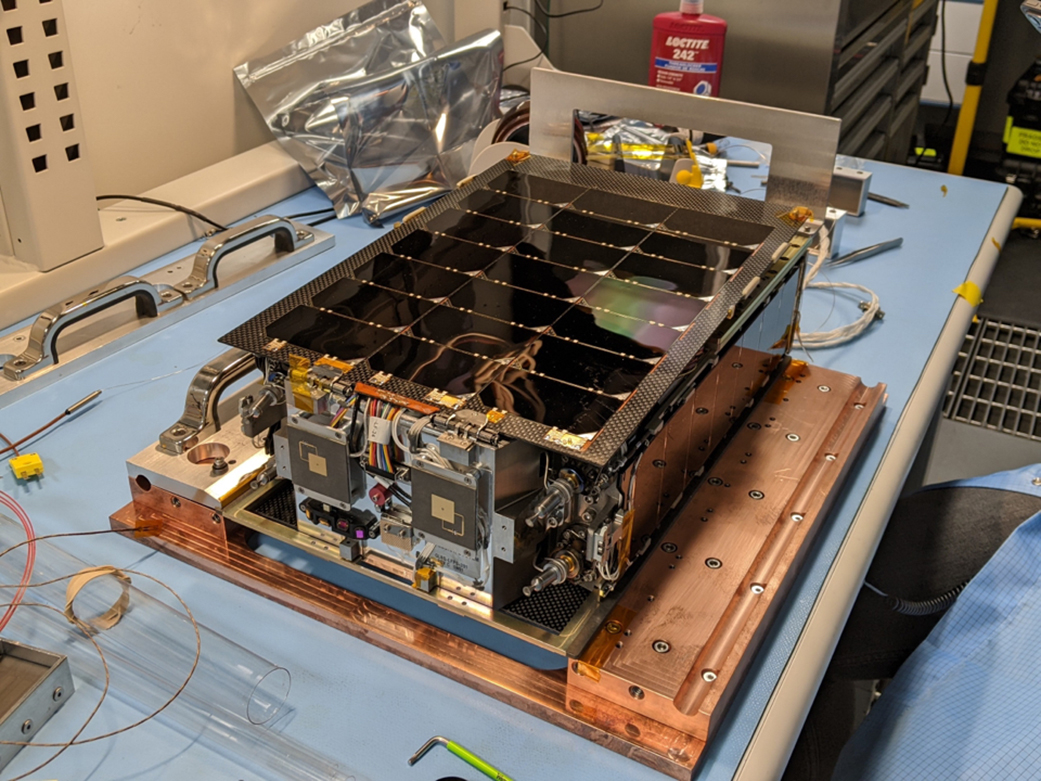
Lunar Flashlight was the most ambitious SST mission — a 6U CubeSat sent to lunar orbit to map water ice in permanently shadowed craters using near-IR lasers. It is also the most published SST project: 61 NTRS citations spanning 2014–2024, across JPL (14), MSFC (31), and GSFC (4+).
PI: John Baker (JPL). Launched December 11, 2022 on SLS Artemis I as a secondary payload (alongside other Artemis CubeSats).
What worked: - Sphinx spectrometer and Iris camera performed as designed - Deep Space Network communication link functioned - First interplanetary CubeSat to use ASCENT (AF-M315E) green propellant - Star tracker demonstrated successful night-sky pointing (Baker, Lo, Sternberg 2022: 20230006952)
What failed: - 3 of 4 thrusters underperformed from the first days of flight - Root cause: obstructions in fuel lines from residual metal powder in the additively manufactured manifold — the 3D-printed propulsion system wasn't cleaned properly after powder bed fusion - Mission terminated May 12, 2023 — unable to enter lunar orbit
Post-mission science (2024): Despite propulsion failure, Cohen et al. published "Lunar Flashlight Science Ground and Flight Measurements and Operations Using a Multi-band Laser Reflectometer" (NTRS: 20240003411, accepted manuscript at GSFC, 2024). This confirms the SWIR reflectometer instrument produced usable science data even without reaching the planned lunar orbit — the most capable subsystems outperformed expectations while propulsion prevented the full mission.
Cross-center collaboration (NTRS authorship analysis): | Center | Citations | Key authors | Role | |--------|-----------|-------------|------| | MSFC | 31 | Cohen, Williams, Huggins, Andrews | Propulsion system, mission science PI | | JPL | 14 | Baker, Sellar, Sternberg, Kowalkowski | Spacecraft bus, instruments, GNC | | GSFC | 4+ | Cohen (moved), Folta | Science operations, trajectory | | GA Tech | 2+ | Lightsey, Cavender, Smith, Peet | Propulsion system controller (SSDL) |
Barbara Cohen spans MSFC and GSFC affiliations across publications — she is the mission's most prolific author and the science PI.
People chains feeding into Lunar Flashlight: 1. Glenn Lightsey (JSC → GA Tech): SSDL developed the COTS-based propulsion system controller (NTRS: 20220009424). This is the JSC→GA Tech people chain from SST project 91360. 2. Mina Rais-Zadeh (U Michigan → JPL): PI on SST phonon trap timing project 91596 at U Michigan (2015–2018). Co-author on the SWIR laser reflectometer instrument paper (NTRS: 20210008744). Her move to JPL Group Supervisor role means two SST people chains converge on Lunar Flashlight. New discovery (session 38).
Lessons for SST: 1. Deep-space CubeSat propulsion remains the hardest subsystem — Lunar Flashlight joins FEMTA and dual-mode projects in the "propulsion stall" pattern. 2. Even failed missions produce technology infusion (Sphinx, Iris, star tracker). 3. The 61 NTRS publications ensure the failure was well-documented and knowledge was preserved — this is the most-published mission in the entire SST portfolio. 4. Cross-center collaboration was deep: JPL (bus), MSFC (propulsion, science PI), GSFC (trajectory), GA Tech (controller), U Michigan (instrument). Five institutions on a 6U CubeSat.
Outcome: partial failure (propulsion), partial success (avionics, comms, science) | Confidence: confirmed
Early-Era Projects (2013–2016)
JPL's two early SST projects reflect the portfolio's initial phase: fundamental subsystem research at TRL 3–5.
Ion Propulsion + Orbit Maneuver 91491: PI Jennifer Hudson. Integrated micro RF ion thruster with control algorithms for CubeSat attitude control and orbit maneuver. Reached TRL 4 and closed out 2016-04-30. No visible downstream, but the integrated propulsion+GNC approach anticipated later systems like Busek's BIT-3.
Low-Temp Energy Storage 91359: PI Sharlene Katz. Battery/ultracapacitor hybrid for deep-space temperatures. Only 1 year of a planned 2-year project. Reached TRL 5 but no follow-on.
NTRS Summary
| Project/Mission | NTRS Citations | Key NTRS IDs | Span |
|---|---|---|---|
| Lunar Flashlight | 61 | 20210020768, 20220001605, 20240003411 (newest) | 2014–2024 |
| MarCO | 7 | 20190033577, 20190025566, 20220000777 | 2016–2020 |
| ISARA | 1 | 20210008645 | 2018 |
| Total | 69 | 2014–2024 |
JPL's 69 NTRS citations make it by far the most-published SST center. The publication record is dominated by Lunar Flashlight, but the quality distribution is notable: Lunar Flashlight's publications include fracture control plans, instrument designs, propulsion development papers, and post-mission science — the full lifecycle of a failed-but-instructive mission.
Institutional Character
JPL's SST role was qualitatively different from ARC's. Where ARC built institutional swarm capability through sequential missions (EDSN→Nodes→V-R3x→Starling), JPL ran one-off, high-ambition missions that pushed SmallSats into new operational domains:
- ISARA: first high-bandwidth CubeSat → enabled first interplanetary CubeSat
- Lunar Flashlight: first CubeSat to lunar orbit with green propulsion (attempted)
JPL's 50% flight rate is the highest among multi-project centers (ARC: 56% across 16 projects but with more modest missions; GSFC: 25%). The tradeoff: JPL's missions were riskier and when they failed (Lunar Flashlight), they failed spectacularly — but the data was more valuable.
Downstream influence beyond SST: JPL's deep-space CubeSat work informed: - PREFIRE twin CubeSats (extended through Sep 2026) — Earth science mission using CubeSat platform heritage - SunRISE (6-CubeSat array) — solar radio interferometry leveraging distributed smallsat concepts - LASSO (DARPA) — very low lunar orbit mission where JPL-developed cislunar CubeSat experience is directly relevant
Cross-References
- ISARA → MarCO → TBIRD lineage — the optical/RF downlink improvement arc
- Smallsat Propulsion — Lunar Flashlight ASCENT failure, ion propulsion
- High-Profile Missions — ISARA, Lunar Flashlight
- Ames Research Center — contrasting institutional strategy (sequential vs. one-off)
- People Chain archetype — Richard Welle (ISARA + OCSD + DiskSat), Rais-Zadeh (U Michigan → JPL Lunar Flashlight)
- University of Michigan — Rais-Zadeh phonon trap timing → JPL Group Supervisor → Lunar Flashlight SWIR instrument
- Johnson Space Center — Lightsey's GA Tech group built Lunar Flashlight's propulsion controller
- Marshall Space Flight Center — MSFC built propulsion system, Barbara Cohen science PI; 31 NTRS citations from MSFC alone
- GPDM convergence — Lightsey also connects Lunar Flashlight to GPDM