Marshall Space Flight Center (MSFC)
Location: Huntsville, Alabama | Role in SST: Propulsion development center SST projects as lead org: 2 | As partner/test facility: 2+
Last updated: 2026-04-14 (session 16)
SST Projects
| SST Project | Technology | TRL | Period | Status | Outcome |
|---|---|---|---|---|---|
| 91492 — Iodine Satellite (iSat) | Iodine Hall thruster 12U CubeSat | 3→6 | 2014-07 → 2017-09 | Completed | transitioned (tech, not mission) |
| 155369 — Green Propulsion Dual Mode (GPDM) | ASCENT green propellant, dual chemical + electrospray | 4→8 (target) | 2022-09 → 2026-09 | Active | unknown (pre-flight) |
Supporting roles: - 106834 — USU 3D Printed Hybrid Propulsion: MSFC tested the 3D-printed hybrid motor for HLS propulsion application. See USU. - Lunar Flashlight propulsion system: MSFC built the ASCENT green propellant system that experienced 3D-printed manifold obstruction in flight. See JPL.
Iodine Satellite (iSat) — The Mission That Never Flew
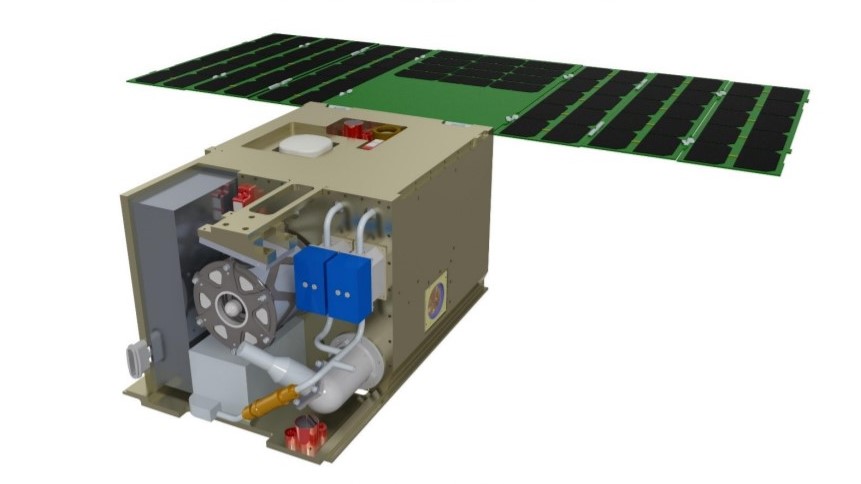
iSat (91492) was designed to be the first CubeSat to demonstrate high delta-V from a Hall thruster using iodine as propellant. A 12U CubeSat would demonstrate plane changes, altitude changes, and controlled reentry in under 90 days.
PI: John W. Dankanich (NASA MSFC) Partners: NASA GRC (thruster testing), Busek Co. Inc. (iodine Hall thruster hardware), USAF (propulsion maturation support) Destinations: Moon, Mars, Earth
What Made iSat Novel
Iodine stores as a dense solid at room temperature — no pressurized tanks needed. This makes it ideal for CubeSats where volume is critical. The 200 W iodine-fed Hall thruster promised up to 300 m/s delta-V from a 12U form factor.
What Happened
The project reached CDR (Critical Design Review) and produced extensive engineering work, but iSat never flew. The SST project ended September 2017. The TechPort record shows TRL 3→6 with no technology outcomes beyond "Closed Out."
The iodine propulsion concept was ultimately first demonstrated in orbit by ThrustMe (French company), which flew a 1.2 kg iodine thruster on the Beihangkongshi-1 CubeSat in November 2020. iSat's ground validation work (feed system design, thruster characterization, materials compatibility) contributed to the broader knowledge base, but NASA was not first to fly.
NTRS Legacy
Despite never flying, iSat produced 11 NTRS publications (2015-2022) — a substantial body of iodine propulsion engineering:
| Year | Citation | Topic |
|---|---|---|
| 2015 | 20150016506 | Project development toward CDR (Dankanich, Kamhawi, Szabo) |
| 2015 | 20150016536 | Propulsion system development (Polzin, Peeples) |
| 2015 | 20150016504 | Thermal analysis (Mauro) |
| 2015 | 20150016488 | Hardware-in-the-loop testing (Polzin) |
| 2015 | 20150016478 | Propulsion system testing (Polzin, Kamhawi) |
| 2016 | 20160008064 | iSat overview (Dankanich, Kamhawi, Szabo) |
| 2016 | 20160009727 | Thermal analysis PDR→CDR (Mauro) |
| 2016 | 20160009741 | Engineering model feed system (Polzin) |
| 2017 | 20170012440 | Propellant feed system design (Polzin, Seixal, Mauro) |
| 2018 | 20180006416 | Iodine propellant flow modeling (Martin, Sawicki, Polzin) |
| 2022 | 20220015272 | Iodine vapor materials exposure (Jerman) |
Key authors: Kurt A. Polzin (propulsion system lead, 6 papers), Stephanie Mauro (thermal, 2), John Dankanich (PI, 2), Hani Kamhawi (GRC thruster expert, shared with Busek).
Green Propulsion Dual Mode (GPDM) — Active Mission
GPDM (155369) is MSFC's active SST project: a 6U CubeSat demonstrating dual-mode propulsion using ASCENT (AF-M315E) green propellant feeding both a 100 mN chemical monopropellant thruster and four electrospray thrusters from a shared tank.
PI/PM: Nehemiah J. Williams (NASA MSFC) Partners: - MIT Space Propulsion Lab (Paulo Lozano) — electrospray thrusters - Georgia Tech SSDL (Glenn Lightsey) — spacecraft design, assembly, integration, testing, and mission operations - Blue Canyon Technologies — bus - MMA Design — solar arrays - Espace Inc. (François Martel) — bimodal ion-chemical integration electronics, $937K SBIR pipeline - Rubicon Space Systems / Plasma Processes — Sprite ASCENT chemical propulsion module, $872K SBIR Phase III, Lunar Flashlight 100 mN thruster heritage - Quasonix, Xiphos — subsystems
GPDM Significance
This is the first dual-mode system that combines chemical and electric propulsion from a single propellant supply in a CubeSat form factor. The chemical thruster provides high thrust for orbit maneuvers; the electrosprays provide high-Isp attitude control and fine translation.
GPDM Supply Chain — Multi-Program SBIR Convergence (Archetype #13)
GPDM is the clearest case of the Multi-Program SBIR Convergence archetype. Three independent SBIR pipelines converge:
- Rubicon / Plasma Processes — ASCENT chemical thruster SBIR (Phase I 102218 2019, Phase II 113181 2021, Phase III $872K 2023) → Sprite chemical module. 19 TechPort projects, $15.4M+ NASA. Dankanich was PM on Phase I (connecting iSat knowledge to the SBIR).
- Espace Inc. — Bimodal ion-chemical SBIR ($125K 2019, $937K 2021, $599K Phase III 2023) → electrospray control electronics. Also PETA (TRL 7 by 2015). Martel/MIT SPL connection.
- MIT SPL (Lozano) — GCD MEP (13649, 2013) + SST Electrospray Explorer (95548) → thruster hardware.
Total STMD funding lines: 6+ (SBIR/STTR ×2 companies, GCD, SST, NSTRF, CIF). The SST project is the integration and flight demo — the R&D was done across earlier programs.
People Chain: Dankanich → GPDM
John Dankanich — iSat PI — appears as co-author on the GPDM "Path to Flight" paper (IEPC-2025). The iSat cancellation did not end MSFC's small spacecraft propulsion program; it evolved into GPDM with a different propulsion architecture.
GPDM Convergence — Three SST People Chains
GPDM is a convergence point for three SST people chains — all co-authors on the IEPC 2025 "Path to Flight" paper:
- John Dankanich — iSat PI (91492) → GPDM Capability Lead. 10-year institutional continuity.
- Paulo Lozano — MIT Electrospray Explorer PI (95548), Accion founder (106827) → GPDM electrospray supplier. His SST-funded technology IS the GPDM payload.
- E. Glenn Lightsey — JSC CubeSat AR&D (91360) → GA Tech SSDL → Lunar Flashlight controller → GPDM spacecraft design/integration. Inherited MSFC partnership from Lunar Flashlight.
This is the 4th convergence discovered (after VISORS, SWARM-EX, BeaverCube) and the first propulsion convergence and first intra-NASA convergence. See GPDM convergence surprise.
GPDM also leveraged 5+ STMD funding lines: GCD (MIT MEP, 2013), CIF (first ASCENT electrospray test), SBIR/STTR (hardware maturation), NSTRF (grad student research), and SST (flight demo). This makes it the most multi-program SST project.
NTRS Publications (4)
- 20250008918 — "GPDM Path to Flight" (IEPC-2025, Dankanich, Williams, Lozano)
- 20240007674 — "GPDM In-Space Technology Demonstration on 6U CubeSat" (SmallSat 2024)
- 20240007811 — "Mission Architecture for GPDM" (SmallSat 2024)
- 20240004070 — "Design, Analysis, Testing, and Flight Activities" (JANNAF 2024)
Supporting Roles
Lunar Flashlight Propulsion System
MSFC built the ASCENT green propellant propulsion system for JPL's Lunar Flashlight mission (106819). The 3D-printed propellant manifold developed an obstruction that progressively restricted flow, preventing the spacecraft from achieving lunar orbit insertion. The mission was terminated May 2023. See JPL for full detail.
GPDM explicitly incorporates Lunar Flashlight lessons (IEPC-2025-495): "Additional additively manufactured parts honing and cleaning practices were applied. GPDM also applied additional inspections for obstructions, multiple filters were included and testing validated cleanliness and FOD mitigation." The paper recommends "general elimination of additively manufacturing components" at this scale. The GPDM propulsion controller ("Foxglove," GA Tech) is "an evolution of the controller flown on Lunar Flashlight." Thruster valves are also Lunar Flashlight heritage. This is the clearest example of a SST flight failure producing direct design improvements in a successor mission.
USU Hybrid Motor Testing
MSFC tested Utah State University's 3D-printed hybrid rocket motor (106834) in the context of HLS (Human Landing System) propulsion applications. See USU.
Assessment
Archetype: Propulsion Development Center — MSFC's SST role mirrors its institutional identity as NASA's propulsion center. Both SST lead projects are propulsion technology demonstrations.
What makes MSFC distinctive in SST:
- Both projects are propulsion, both use innovative propellants. iSat: iodine (dense solid, no pressurized tanks). GPDM: ASCENT green (low-toxicity, dual-mode). MSFC consistently pushes propellant innovation for small spacecraft.
- 11-paper legacy from a mission that never flew. iSat's NTRS output exceeds many projects that did fly. The engineering knowledge persists even though the mission didn't.
- Dankanich continuity. The PI who led iSat (2014-2017) appears on GPDM papers (2024-2025). Institutional propulsion expertise compounds across project boundaries.
- ASCENT propellant thread and roadmap. ASCENT appears in three SST stories: Lunar Flashlight (MSFC-built, failed in flight), GPDM (MSFC-led, active), and Phase Four RF thruster testing (155356). MSFC is the institutional home for ASCENT expertise. Per the IEPC paper, NASA plans post-GPDM procurements for 5N and 22N ASCENT thrusters — GPDM is one step in a broader green propulsion strategy. AFRL and USSF are named stakeholders with "significant interest" in ASCENT dual-mode operations.
- ThrustMe as counterfactual. iSat's cancellation meant a French company demonstrated iodine propulsion first. The technology matured but NASA lost the flight first-mover advantage.
Launch status (session 15): GPDM was manifested for January 2026 launch per the IEPC paper (September 2025). As of April 2026, no launch confirmation found. The Jan 2026 Twilight rideshare did not include GPDM. Launch appears to have slipped. TechPort last updated 2026-01-22.
Outcome: iSat is "transitioned" (technology matured to TRL 6, knowledge published, but mission never flew). GPDM is too early to assess.